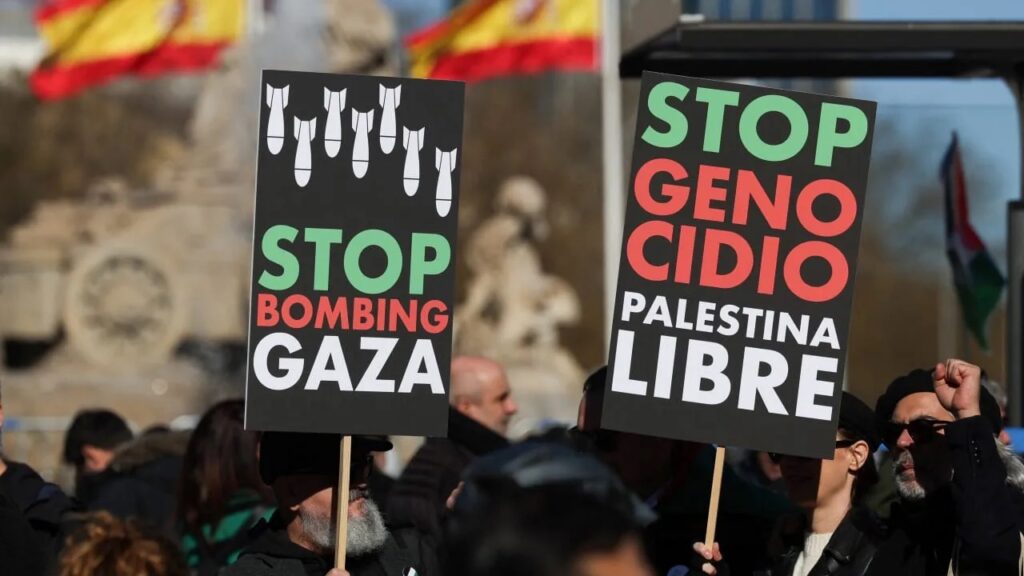


Around 200 pro-Palestinian demonstrators gathered outside Madrid’s Teatros del Canal theatre on Thursday, demanding the cancellation of performances by Israel’s internationally renowned Batsheva Dance Company. Despite calls for a boycott and accusations directed at audience members, the opening performance went ahead and reportedly received a standing ovation, The Jerusalem Post reports
Protesters waved Palestinian flags and displayed a banner declaring, “Israel dances while it kills in Gaza.” Some shouted “Murderers” and “Shame on you” at people entering the theatre.
The demonstration targeted Batsheva’s production of Sadeh21, choreographed by Israeli artist Ohad Naharin, which was scheduled for October 15–17 at the theatre’s Concha Velasco auditorium. According to Spanish media, all three performances sold out.
The Israeli Embassy in Spain confirmed that the opening show proceeded successfully despite the protests.
Among those demanding cancellation was prominent Spanish dancer and choreographer Nacho Duato, who had previously criticised the performances on social media.
Duato questioned why an Israeli dance company receiving public funding was permitted to perform in Madrid when Russian companies had faced cultural boycotts following Russia’s invasion of Ukraine.
Spanish actress Goizalde Núñez joined the demonstration, while filmmaker Javier Fesser also criticised the public funding associated with the performances.
Duato attracted further controversy after footage circulated online in which he described Hamas as a “liberation movement” and declined to recognise it as a terrorist organisation.
Israel’s embassy condemned his position, accusing him of supporting the organisation responsible for the October 7, 2023, massacre in southern Israel while campaigning to exclude Israeli performers.
The embassy subsequently congratulated Batsheva on its successful opening performance, the audience’s standing ovation and the sold-out engagement.
However, the dance academy bearing Duato’s name adopted a markedly different approach.
Following Thursday’s performance, the academy shared an Instagram photograph of its students alongside Batsheva dancers, thanking the company for an unforgettable evening and expressing support for peace, mutual respect and artistic cooperation.
Theatre Refuses to Cancel Israeli Performances
The protests were organised by the Boycott, Divestment and Sanctions (BDS) movement and Palestinian solidarity organisations.
Campaigners argued that Batsheva’s receipt of Israeli government funding made the company a means of promoting Israel’s international image. The theatre’s workers’ committee also opposed hosting the performances.
Nevertheless, theatre director Ruperto Merino rejected the demands, explaining that artistic programming was determined by professional rather than political considerations.
He maintained that the theatre would not censor artists because of their nationality.
Batsheva also rejected suggestions that it represented the Israeli government.
Speaking to the Spanish newspaper El País, a company spokesperson explained that Batsheva was not a political organisation and that its members held differing opinions.
She said the company had publicly supported a ceasefire, the release of hostages and an end to the bloodshed in Gaza since October 7.
The spokesperson also highlighted Naharin’s longstanding opposition to Israeli government policies and the occupation of Palestinian territories.
She noted that Batsheva had previously faced attempts by Israeli governments to reduce its funding because of its political positions.
According to the company, receiving public funding does not mean representing the government, since such resources belong to citizens.
The spokesperson added that Batsheva was accustomed to demonstrations outside its performances and sought to avoid confrontation.
Wider Concerns Over Cultural Boycotts
The Madrid controversy follows the publication of a report by the Anti-Defamation League (ADL) documenting the exclusion and harassment of Jewish, Israeli and Zionist artists in the United States.
Published on October 1, the report, State of the Arts, examines discrimination across music, dance, theatre, film, literature, publishing, museums and the visual arts.
Its chapter entitled “Dark Stage” identifies 65 incidents across 41 American locations involving protests, harassment, disrupted performances or cancellations affecting Jewish and Israeli performing artists.
Batsheva is among the organisations mentioned, alongside Jewish singer Matisyahu and the Israel Philharmonic Orchestra.
Other prominent performers have also experienced protests connected with their Jewish identity or support for Israel.
Comedian Jerry Seinfeld recently faced disruption during a performance in Chicago, following several years of demonstrations over his support for Israel and expressions of sympathy for victims of the October 7 attacks.
In May 2024, dozens of students walked out during his commencement address at Duke University. The ADL also documented an August campaign seeking to cancel his performances in Washington.
Singer Regina Spektor has faced heckling during a concert, while comedian Judy Gold experienced antisemitic abuse while performing.
The ADL warned that visible demonstrations represent only part of the problem.
Its chief executive, Jonathan Greenblatt, said discrimination also occurs through decisions made privately by publishers, cultural institutions and event organisers.
The report described what it called “silent boycotts”, involving withdrawn invitations, abandoned collaborations, cancelled opportunities and reluctance to employ Jewish or Israeli artists.
Israeli singer Noga Erez has reported losing international performance opportunities because of her nationality.
In publishing, the ADL documented cases of authors being encouraged to remove Hebrew expressions, change Jewish characters’ names or avoid Israeli settings to improve their prospects of publication.
The report also examined the policies of 40 leading American museums. Twelve received the organisation’s lowest rating because of shortcomings concerning Jewish representation and institutional policies.
None of the museums explicitly included Jewish identity in their diversity and inclusion commitments.
The ADL argued that these findings demonstrated how discrimination against Jewish and Israeli artists could extend beyond public protests into professional exclusion and restricted cultural opportunities.
In Madrid, however, the theatre’s refusal to cancel Batsheva’s performances allowed the company to complete its scheduled engagement despite political pressure.
Photo credit: REUTERS/Isabel Infantes
 More News