

A museum in the Netherlands has cancelled an exhibition celebrating the 300th anniversary of a historic synagogue, citing concerns about tensions surrounding the Israeli-Palestinian conflict. The decision has prompted accusations of antisemitism from Dutch Jewish leaders, who warn that Jewish history and culture are increasingly being excluded from public life because of events in the Middle East, The Jerusalem Post reports.
The exhibition at Museum Amersfoort was scheduled to open in early 2027 to commemorate the tricentenary of the Amersfoort Synagogue, which opened in 1727. The building is recognised as the oldest Ashkenazi synagogue in Western Europe still in use.
However, on November 4, Paul Baltus, director of Amersfoort in C, the organisation responsible for the museum and several other cultural institutions, announced that the exhibition would not proceed as planned.
Baltus attributed the decision to growing social tensions and concerns about the pressure that potential protests could place on museum employees and volunteers.
“Since then, the social climate has changed significantly,” he said, referring to the five years of preparation for the exhibition. “The situation in the Middle East is also having an impact on Dutch society. The public debate on this subject can be heated and, at times, lacking in nuance.”
He argued that the museum, as a relatively small organisation, lacked the resources to manage potentially confrontational reactions.
“As a small and vulnerable organization, I do not want to expose my staff to that kind of pressure,” Baltus explained.
Although additional security measures, including guards and surveillance cameras, were possible, he maintained that volunteers would still face difficult situations.
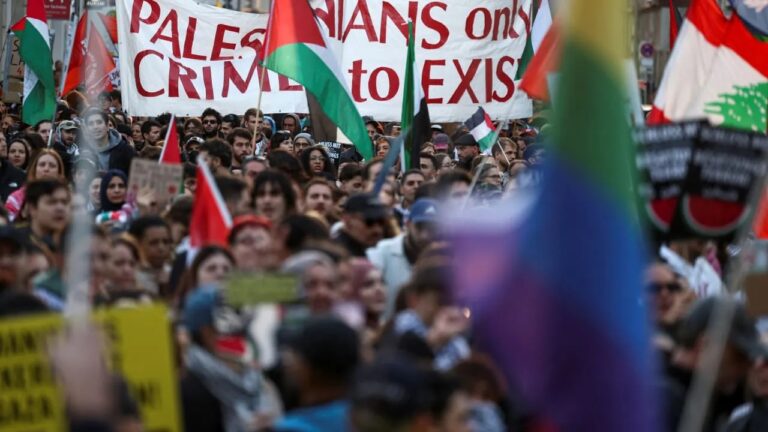
The decision came amid widespread pro-Palestinian demonstrations in the Netherlands following the Hamas-led attacks against Israel on October 7, 2023. On November 8, tens of thousands of protesters gathered in Amsterdam to demand stronger Dutch sanctions against Israel.
Mayor Intervenes Following Jewish Community’s Objections
Jewish organisations expressed shock at the cancellation, arguing that a celebration of centuries of Jewish life in the Netherlands should not become a casualty of political disagreements over Israel.
Amersfoort Mayor Lucas Bolsius intervened, telling the City Council on November 4 that municipal authorities would seek a way to ensure the exhibition could proceed.
He acknowledged the distress caused by the museum’s announcement, saying it had reinforced feelings among Jewish residents that they were unwelcome.
The decision “has caused considerable pain within the Jewish community, particularly by reinforcing the feeling that its members are not welcome or even allowed to exist”, Bolsius told councillors.
Following discussions with Baltus, the mayor announced on November 6 that both parties would explore possible solutions.
Bolsius said organisations and individuals from Amersfoort and elsewhere in the Netherlands, including central government representatives, had offered assistance.
“People and organizations want to help make this exhibition possible,” he said.
Baltus subsequently acknowledged that these offers had eased some of his concerns.
“With this support, we will explore the possibilities with an open mind and a positive intention, in consultation with the Jewish community,” he stated.
Nevertheless, the exhibition’s opening remained uncertain.
Jewish Leaders Warn of Growing Cultural Exclusion
Hans Weijel, vice-chairman of the Centraal Joods Overleg (CJO), which represents the interests of approximately 40,000 Jews in the Netherlands, welcomed the mayor’s intervention.
“We are very glad the mayor intervened. Let this be an example for other authorities,” he told the Jewish Telegraphic Agency.
However, Weijel condemned the original cancellation, arguing that Jewish heritage should not be treated as controversial because of a conflict thousands of kilometres away.
He emphasised that Jews had contributed to Amersfoort’s civic and cultural life since the mid-17th century.
“We think it is ridiculous that a museum in a city doesn’t want to have an exhibition about a 300-year-old synagogue and its history in that city. The conflict is in the Middle East, not here,” he said.
“If you want proof that this is antisemitism, this is the proof.”
Weijel also accused Baltus of cowardice, saying that fear of possible disturbances was insufficient justification for abandoning the exhibition.
“He’s afraid something bad will happen, but if you’re that afraid, you should stay in bed,” he remarked.
Emile Schrijver, director-general of Amsterdam’s Jewish Cultural Quarter, expressed similar concerns.
The organisation oversees several major Jewish heritage institutions, including the Jewish Museum, the National Holocaust Museum and the Portuguese Synagogue.
Schrijver criticised Museum Amersfoort for cancelling the exhibition without consulting the Jewish community or the organisations involved in its preparation.
He said Jewish artists and cultural institutions had faced increasing difficulties securing venues since October 7, 2023.
“Jewish artists have had a difficult time finding a stage, and Jewish events, including cultural, can’t find a venue. Jewish events are being canceled for no reason,” he explained.
Schrijver also challenged the museum’s argument that security concerns made the exhibition impractical.
His own institutions regularly organise public events despite protests and potential security threats.
“We train our staff all the time. We deal with this every day. Yes, it’s difficult, but no, it’s not impossible,” he said.
Concerns Over Making Jewish Identity a Security Issue
Schrijver warned that repeatedly treating Jewish cultural activities as security risks could gradually remove Jewish communities from public spaces.
“The effect of this is that the normality of Jewish presence in a town is being pushed away,” he said.
“Suddenly anything Jewish is considered a security hazard or prone to cause problems.”
He argued that museums and other cultural institutions must distinguish between political opinions about Israel and their responsibility to preserve the history of Jewish communities in Europe.
“You have to separate your private opinion from the long history of a small town in the Netherlands,” Schrijver said.
“What they’re effectively doing is pushing the Jewish community to the fringes of society.”
In his original announcement, Baltus acknowledged the disappointment caused by the cancellation and proposed alternative ways to commemorate the synagogue.
These included providing historical artefacts and museum expertise for an exhibition held inside the synagogue itself, as well as incorporating its history into the museum’s permanent displays about Amersfoort.
However, Jewish representatives maintained that these alternatives did not address the wider implications of withdrawing a public exhibition dedicated to Jewish heritage.
For Schrijver, the controversy illustrates a growing tendency to judge Jewish cultural life through the lens of the Israeli-Palestinian conflict rather than recognising it as an integral part of European history.
“The moment you make Jewish history dependent on what is happening in the Middle East, you are making Jewish existence conditional,” he concluded.
photo credit: REUTERS/CHRISTIAN MANG
 More News