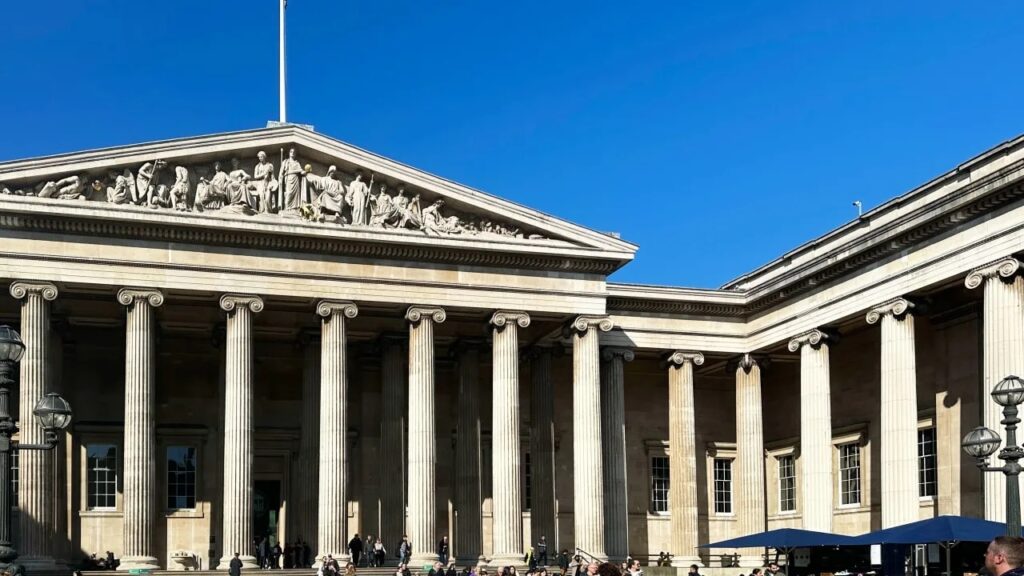


The British Museum has removed the term “Palestine” from certain Middle East gallery panels after concerns were raised that its use was historically inaccurate for ancient periods. The decision follows complaints from a UK legal advocacy group and reflects broader sensitivities around terminology linked to modern political disputes, reports The Jerusalem Post.
The museum confirmed that it is reviewing graphic panels and maps in its Middle East galleries as part of a planned refurbishment. In particular, displays covering the later second millennium BCE now refer to the southern Levant as “Canaan,” which scholars widely recognise as the historically accurate term for that era.
The changes come after UK Lawyers for Israel (UKLFI) formally objected to what it described as anachronistic references to “Palestine” in exhibits covering the ancient Levant and Egypt. In a letter to the museum, UKLFI argued that applying the term retroactively to periods when no such political or geographic entity existed “risks obscuring the history of Israel and the Jewish people.”
The organisation stated that using a single name across thousands of years “erases historical changes and creates a false impression of continuity.” It called on the museum to refer to regions using historically accurate terms such as Canaan, the kingdoms of Israel and Judah, or Judea, depending on the specific time period.
In response, the British Museum explained that while “Palestine” has long been used in both Western and Middle Eastern scholarship as a geographical designation for the southern Levant, it recognises that the term “no longer holds a neutral designation and may be understood in reference to political territory.”
For modern maps, the museum said it has opted to use United Nations terminology, including Gaza, the West Bank, Israel, and Jordan. It also clarified that the term “Palestinian” is used as a cultural or ethnographic identifier where appropriate.
According to UKLFI, panels in the Levant gallery covering the period 2000–300 BCE have already been updated to describe the history of Canaan and the Canaanite civilisation, as well as the rise of the kingdoms of Israel and Judah. In the Egypt galleries, one panel was amended to replace the phrase “Palestinian descent” with “Canaanite descent.”
A spokesperson for UKLFI welcomed the museum’s decision to review its terminology, noting that museums “play a vital role in public education” and that historical descriptions should reflect the record with “precision and neutrality.”
The issue highlights how debates over language and historical framing can intersect with contemporary political tensions. While the museum has framed the changes as part of routine review and refurbishment, the decision also reflects the growing sensitivity around terminology related to the Israeli–Palestinian conflict.
Photo credit: Peter Dazeley/Getty Images
 More News